
Jūnzǐ Bàochóu | The Iran War Is China Delivering Trump a Gentleman's Revenge for 10 Years of Insults
The opportunity of defeating the enemy is provided by the enemy himself.
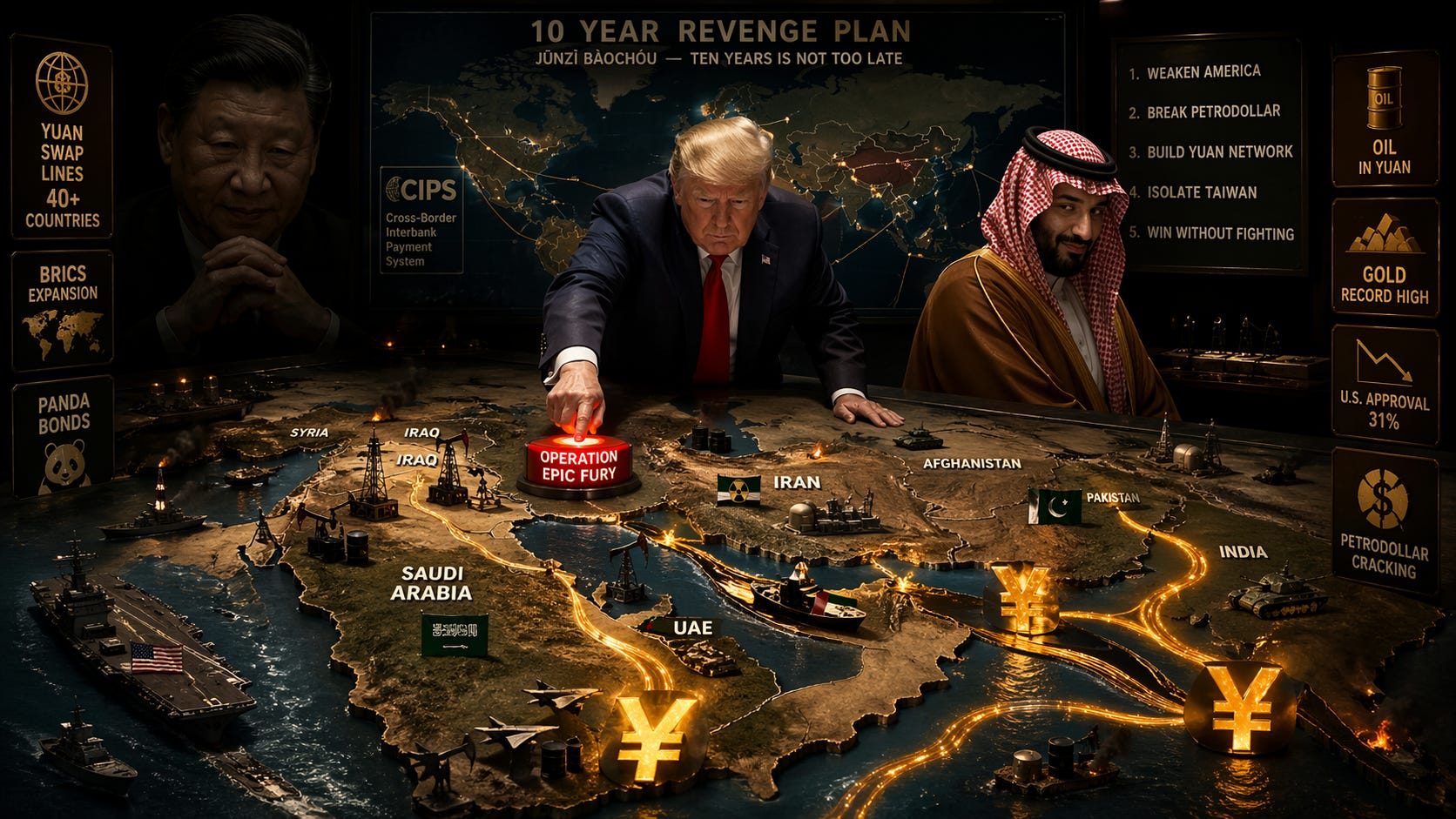
Sun Tzu, The Art of War, 5th Century B.C.
China did not need to fire a shot to win the 21st century. It only needed to wait for an American leader arrogant enough to pull the trigger for them.
Since 2018, the world has watched what looked like a one-sided bullying campaign. Washington unloaded on Beijing with a barrage of tariffs, sanctions, chip bans, and public humiliations. It flexed in the Panama Canal. It moved to squeeze China’s partners in Venezuela. To the hawks in the White House, it felt like China was reeling, a passive and weakened power that could finally be pushed out of the global order.
It was the ultimate deception.
Eight days ago, that president got on a plane and flew to Beijing. His first state visit to China since 2017. Xi greeted him at the Great Hall of the People. China’s foreign ministry called the summit “historical.” While he was there, he told Fox News on the record that the United States had “allowed” three Chinese tankers carrying Iranian oil to transit the Strait of Hormuz. The same strait American taxpayers are spending $29 billion to keep contested. Xi did not come to him. He went to Xi.
That is not a footnote. That is the architecture finally surfacing.
Pretend to be weak, that he may grow arrogant.
Sun Tzu, The Art of War, 5th Century B.C.
Beijing was not retreating. It was practicing strategic patience. While absorbing every insult with a smile, it was quietly rewiring the global system, the infrastructure, the money flows, the alliances, the intelligence channels, so that when Washington finally lashed out, the blow would land on America itself. By the time the administration turned its sights toward Iran, the board was already set. The right fragments of intelligence were in the right places. The right countries were deep enough in China’s network to cushion themselves and let the dollar take the hit. The right leaders in the Gulf had one eye on Washington and the other on Beijing, ready to hedge the moment America overreached.
The bait had been taken.
The skillful leader subdues the enemy’s troops without any fighting.
Sun Tzu, The Art of War, 5th Century B.C.
The Iran War is not an accident or a show of strength. It is the activation of a long, patient plan. The aim is not to destroy the United States. The aim is to end American exorbitant privilege and make the dollar normal. Before this decade ends, when the dollar is just another currency, the last act of this story will be China bailing out the United States. An American president will stand at a podium and thank Beijing for stabilizing the global financial system, and Xi and his successor will have done it without ever firing a shot.
The opening hour of the war tells you everything. On February 28, 2026, joint US-Israeli airstrikes killed Supreme Leader Ayatollah Ali Khamenei in his Tehran compound, along with his wife, son, brother-in-law, and forty senior military officials. The Assembly of Experts elevated his son Mojtaba Khamenei on March 8. Mojtaba has not been seen in public once since. Iranian state media is now releasing AI-generated videos of him. Trump told Fox News Radio that Mojtaba may be alive, may be dead, may have lost a leg. Nobody knows.
Everything that follows is how the trap was built.
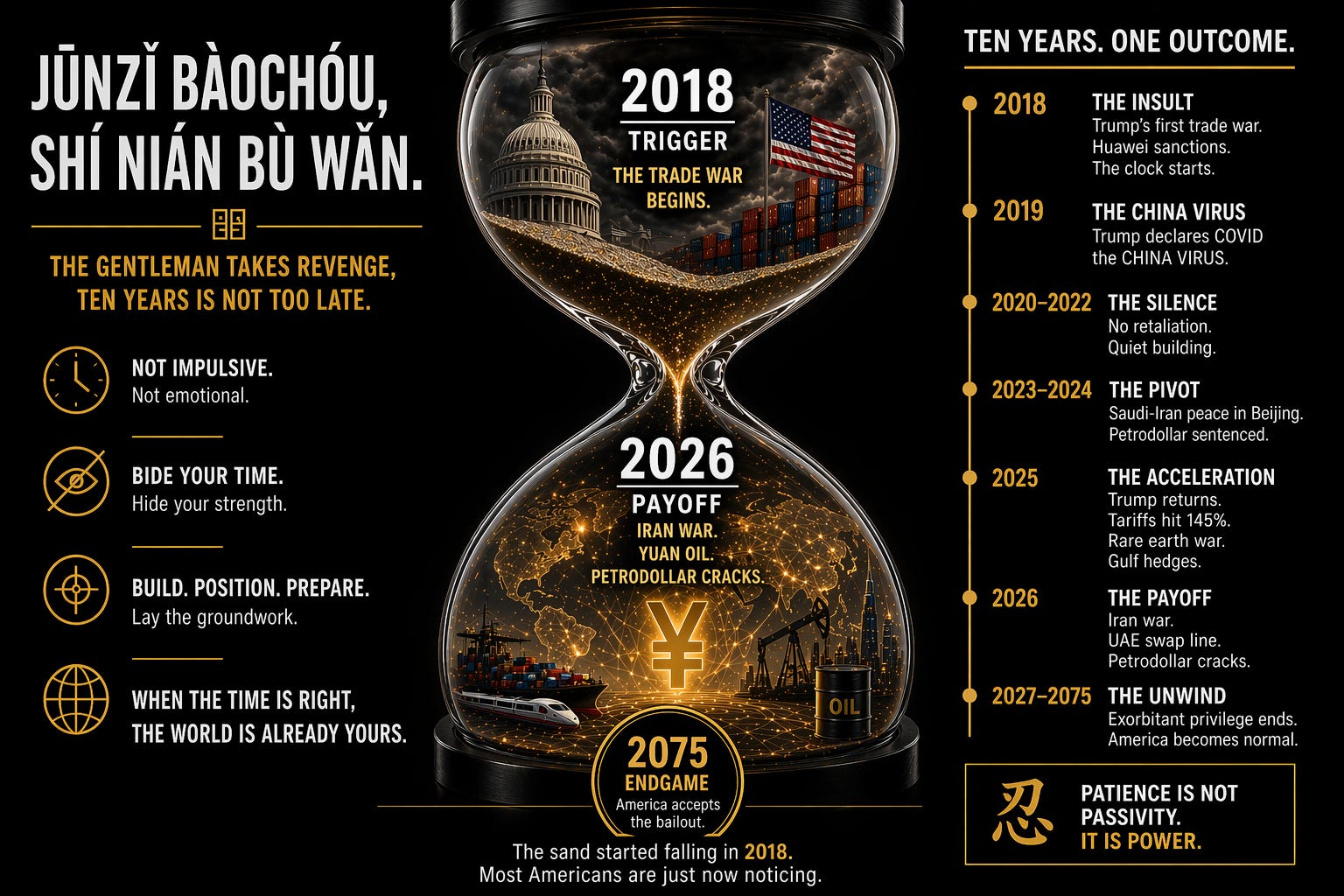
The Proverb That Explains Everything
Jūnzǐ bàochóu, shí nián bù wǎn. A gentleman’s revenge. Ten years is not too late.
It is a Chinese proverb describing exactly what Chinese President Xi Jinping has done. Absorb the insult. Smile at the summit. Wait a decade or five. Restructure the entire field of play so the insulter loses everything he thought was permanent, without ever knowing who hit him.
The patience is the weapon. By the time the target understands what happened, there is no counter-move left to make, because the terrain itself has been redrawn.
What Xi Actually Wants
Most Americans misunderstand what China is doing. So do most American strategists.
They think Xi wants to replace the dollar with the yuan as the world’s reserve currency. They think he wants to be what Nixon and Kissinger built America into in 1974: the center of the global financial system, the country whose currency everyone else is forced to hold, the nation that gets to run deficits forever because the world has no choice but to fund them.
Xi does not want that.
Xi knows what reserve currency status actually costs. It means your currency is too strong to compete on exports. It means you have to run massive trade deficits to supply the world with liquidity. It means your economy gets hollowed out manufacturing‑wise because other countries can never buy enough of your goods to balance the dollars you ship out.
Reserve currency status is how America lost its industrial base. It is why American workers spent forty years watching factories close while Wall Street got richer. It is the curse dressed as a crown.
China spent the last thirty years becoming the manufacturing hub of the planet. They are not giving that up to play Treasury banker to the world. That is not revenge. That is self‑destruction.
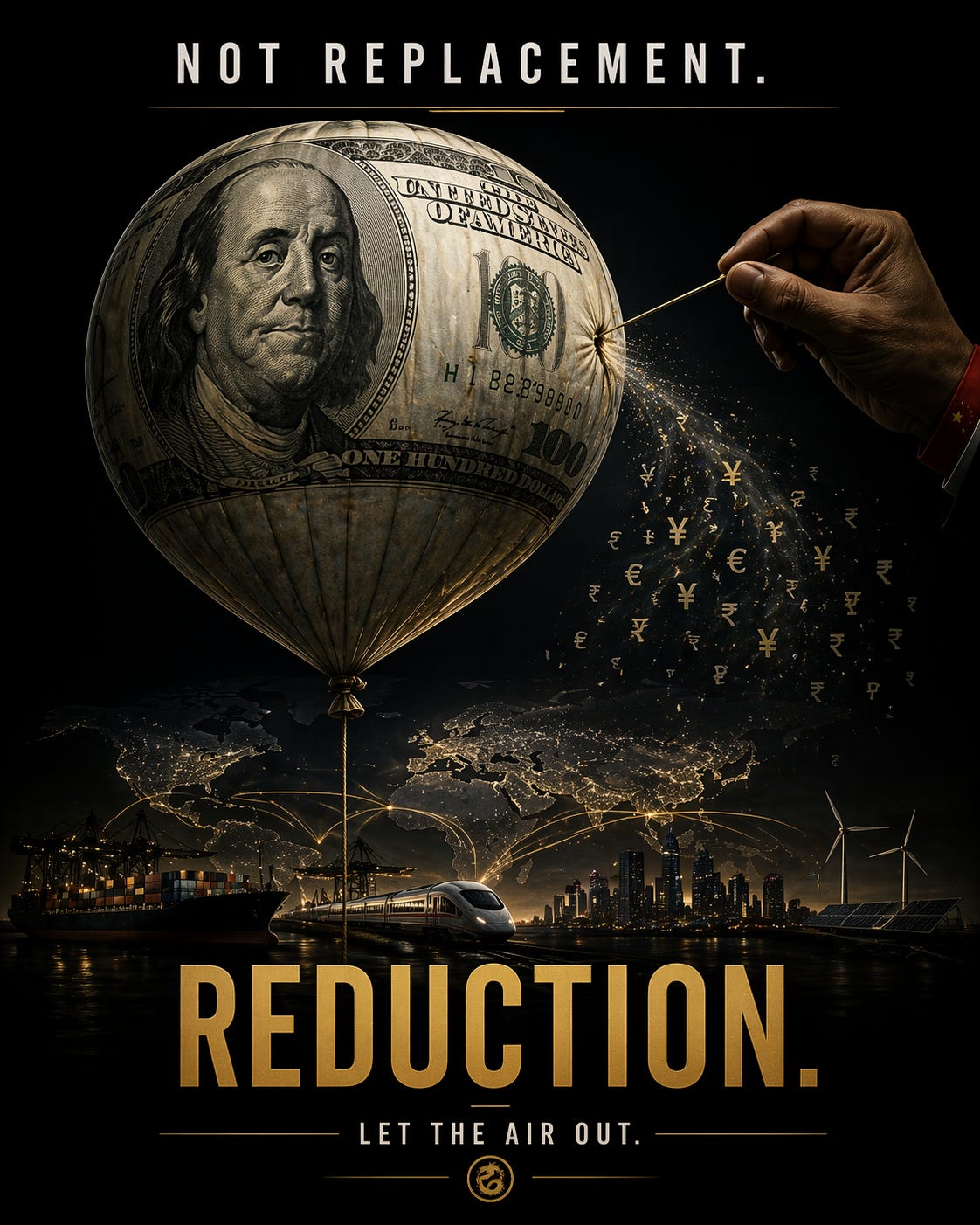
Letting the Air Out of the Dollar
Xi wants to let the air out of the balloon. Slowly. Patiently. Over fifty years if that is what it takes.
He wants to end the exorbitant privilege, the free lunch America has eaten since 1974, without triggering a collapse that drags China down with it. He wants the dollar to become normal. Just another currency. Useful, not dominant. Accepted, not required. One option among several, instead of the only game in town.
Because when the dollar is normal, America is normal. And America has never been normal.
The entire post‑1945 economic order is built on the assumption that America is different, that American deficits don’t matter, that American debt can grow forever, that American sanctions are a sentence no country can appeal. Kill the privilege and you kill the assumption. Kill the assumption and American power becomes constrained by the same rules that constrain every other country.
That is what Xi wants. Not conquest. Containment. Not replacement. Reduction.
The Endgame: America Thanks Him For It
The final act, the one historians will write about in 2075, is the one Americans will never see coming.
When the debt burden finally becomes unsustainable. When interest payments cannibalize the federal budget. When the dollar has lost enough special status that America can no longer borrow its way out of trouble.
China will step in. It will offer stabilization. Liquidity. A managed transition. A gentle landing.
And America will take it. Because the alternative will be collapse. A grateful American president, standing at a podium somewhere in the 2070s, will thank Xi’s successor for saving the global financial system.
That is the revenge. Not destruction. Dependence. A reversal so complete that the insulter ends up in debt to the insulted, and grateful for the charity.
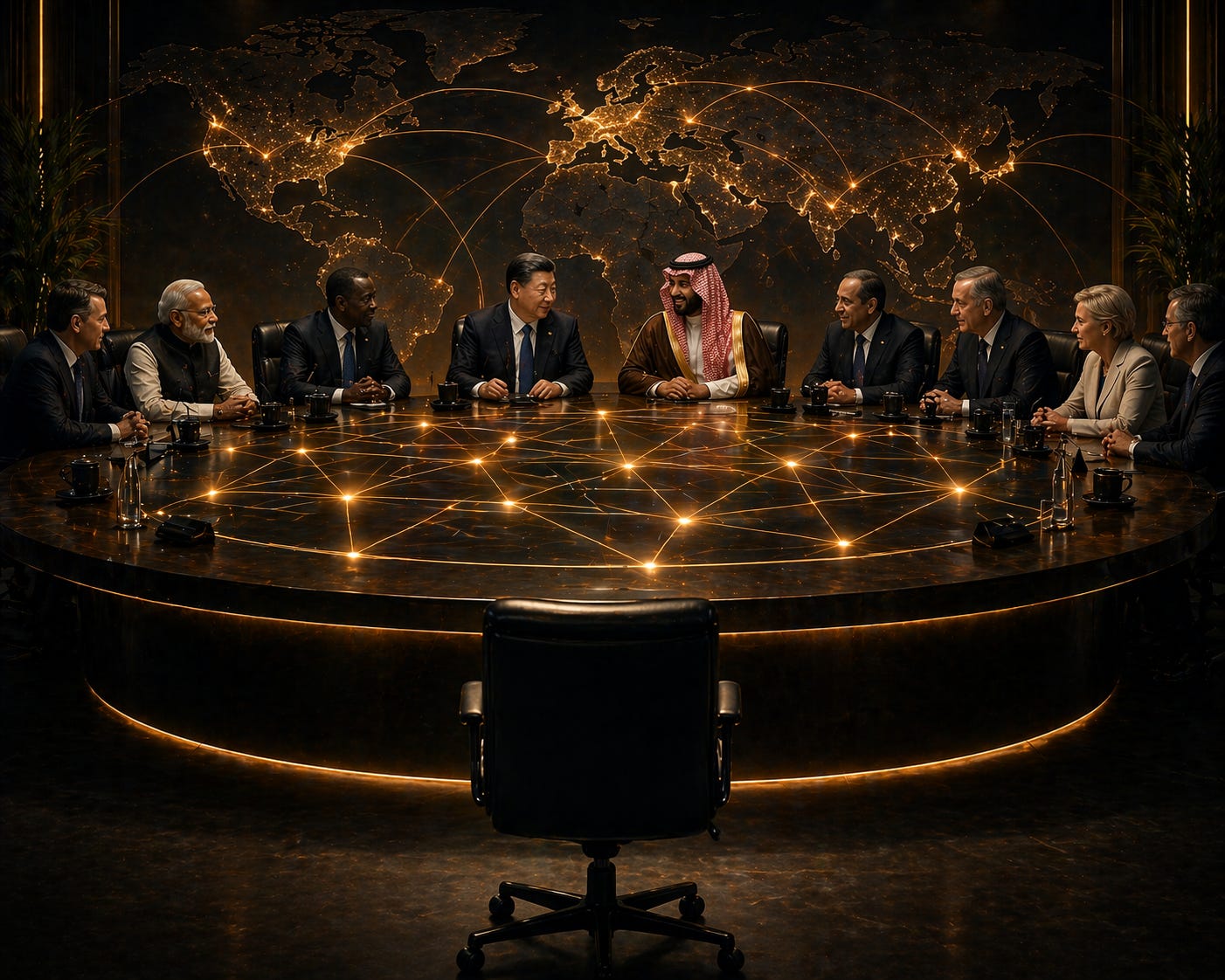
It Works Now Because The World Has Turned Against America
This could not have worked five years ago. It works now because the entire world has turned against the United States.
Not since 1945 has America been this isolated, this mistrusted, this openly resented by allies and rivals alike. Polling across NATO shows record-low confidence in American leadership. The Pope is publicly rebuking the American president. Spain, Italy, France, Mexico, Brazil, and Canada are coordinating independently of Washington on trade, climate, and defense. Japan and South Korea are quietly exploring their own hedges. Germany is rebuilding its military around the assumption that America may not be there when needed. The United Kingdom is negotiating with Brussels to repair what Brexit broke.
For the first time in the post-1945 era, a sitting American president is seen by a majority of allied democracies as a direct threat to their security and economic stability, not a guarantor of it.
Trump threatens to cut trade with Spain over an airbase. He dumps Italy over Meloni’s policy demands. He fights publicly with the Pope. He posts AI-generated images of himself as Jesus Christ. He accuses his own Supreme Court of corruption after losing the tariff ruling. He tells NATO members to pay up or get abandoned. He treats seventy-year alliances as renegotiable leases.
Every leader watching this came to the same conclusion: America is no longer a reliable partner. Plan accordingly.
Xi has spent a decade telling these same leaders that America cannot be trusted, that the dollar system is a trap dressed as a partnership, that dependency on Washington is a vulnerability waiting to be exploited. Every Trump tweet proves his point. Every abandoned ally validates his pitch. Every tariff makes his alternative more attractive.
What America Actually Did to Xi Jinping
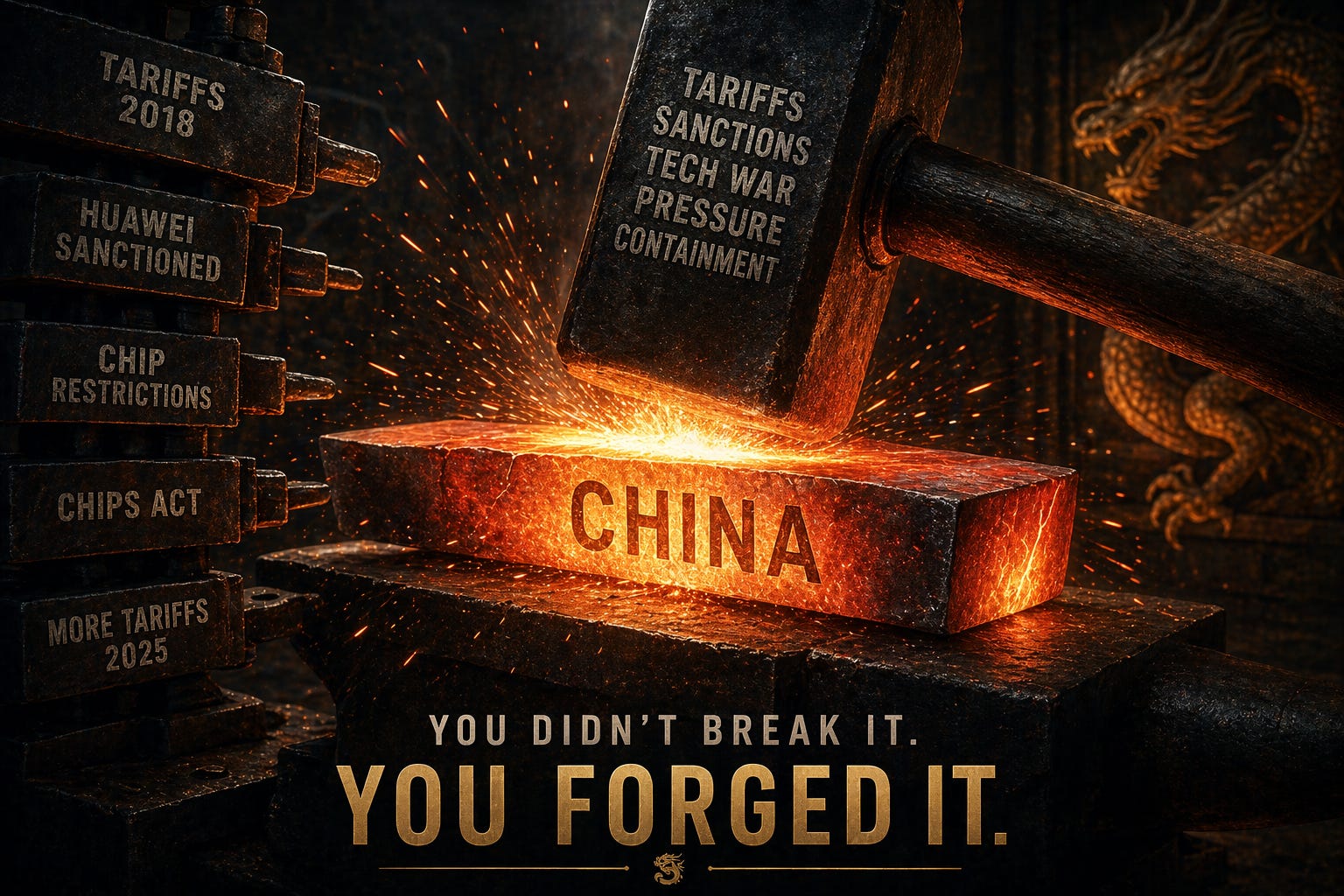
Trump imposed tariffs in 2018. Sanctioned Huawei. Blocked advanced chips. Publicly humiliated Xi at summit after summit with the “China Virus.”
Biden kept the tariffs. Expanded the chip war. Passed the CHIPS Act to cut off Chinese access to the semiconductors needed for 21st-century everything.
Trump returned in 2025 and went further. Published a National Security Strategy that named China the primary adversary of the United States. Muscled Chinese operators out of the Panama Canal. Pushed Chinese-backed infrastructure out of Venezuela. Imposed more tariffs. Threatened more sanctions.
And after all of that, America assumed Xi would do nothing?
That assumption is the mistake that defines this entire decade. America kept believing that because China did not retaliate visibly, China was not retaliating. Every administration read silence as weakness.
They did not understand they were reading a strategic tradition three thousand years older than the United States. Silence is not weakness in Chinese strategic culture. Silence is preparation. The fact that you can hear the attack coming means it has already failed.
Xi Didn’t Retaliate. He Built the Belt and Road Initiative
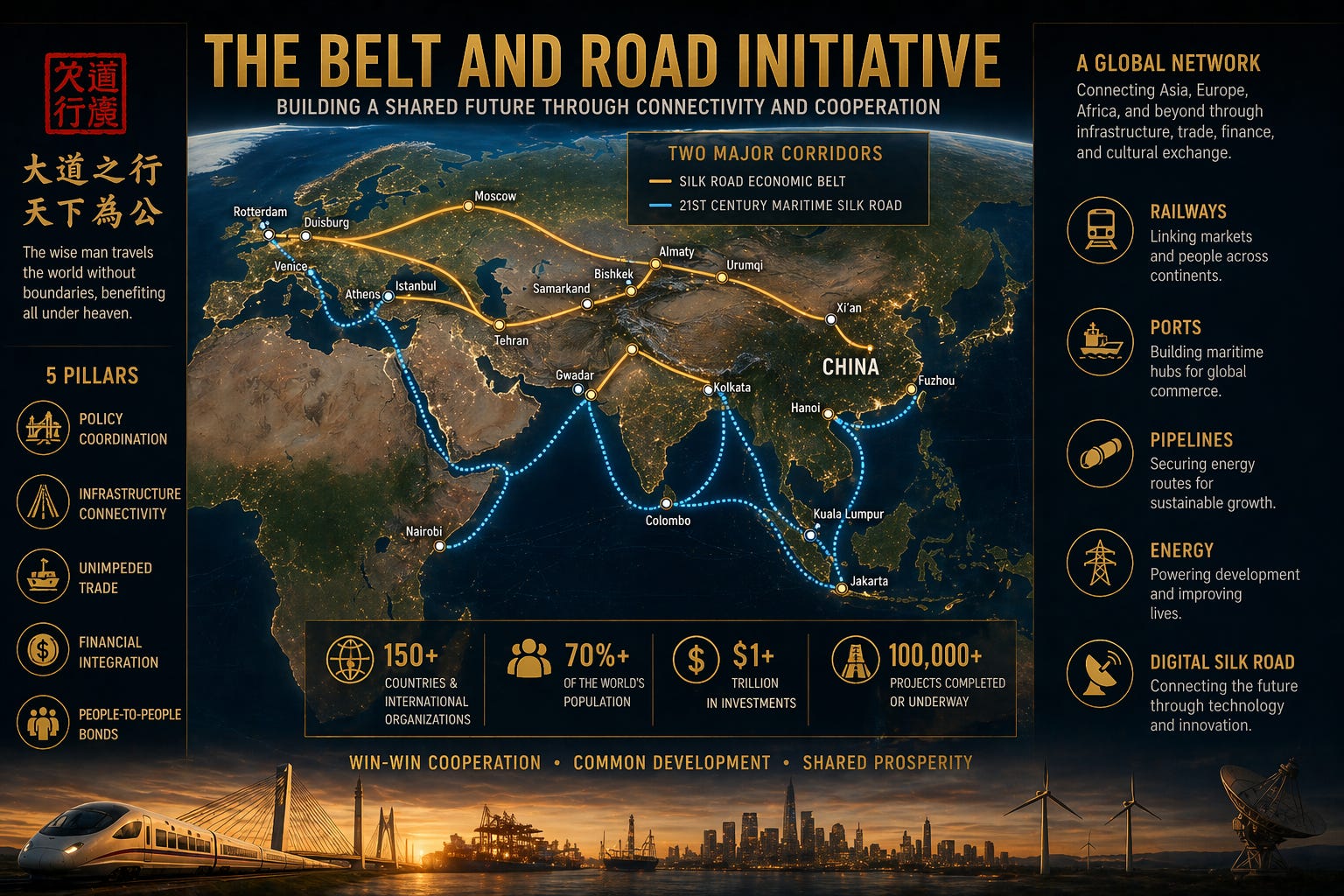
He stepped on the gas put the Belt and Road Initiative into hyperdrive. Launched in 2013, it is now the largest infrastructure project in human history. Over one trillion dollars committed. More than 150 countries signed on. Sixty percent of the world’s population. Forty percent of global GDP.
This is not a development project. It is a global wiring diagram.
China builds ports, railways, power plants, telecom networks, pipelines, and data centers for countries that could not otherwise afford them. Chinese banks finance. Chinese companies construct. The host country signs on.
Pakistan has over $60 billion in projects. Greece sold China its largest port. Sri Lanka handed over a 99-year lease on Hambantota after defaulting. Djibouti hosts China’s first overseas military base, seven miles from an American one. Ports in Malaysia, Indonesia, Kenya, Nigeria, Peru, Argentina, and Panama. Huawei networks in more than 70 countries. Undersea cables. 5G. Data centers.
When Americans think about China, they think about factories that make iPhones. That is not the threat. The threat is the global infrastructure China has spent a decade embedding into 150 countries. The logistics of a quiet war.
On top of Belt and Road, he built the rest of the machine.
He built CIPS, the payment system that bypasses the dollar. He opened yuan swap lines with forty-plus countries. He brokered the Saudi-Iran peace deal in Beijing in March 2023, the day Xi attemped to end the petrodollar story. He brought Saudi Arabia, UAE, Iran, and Egypt into BRICS. He locked in yuan oil contracts across the Gulf.
And when the infrastructure was ready, he activated it.
The Argument China Wants You to Have
When the Iran war started, the online argument went exactly where you would expect. One side: “Israel did this.” The other side: “No, Israel is innocent.” The fight was intense, emotional, and endless. Almost no one stopped to ask a colder question: on a twenty‑year horizon, who quietly gains the most from an American war in the Persian Gulf. From Beijing’s point of view, the answer is almost funny: the people who blame Israel and the people who defend Israel are fighting the same scripted battle, and China is laughing at both.
Every time something big happens in American foreign policy, a familiar chorus emerges online blaming Israel. The names change, the maps change, the hashtags change, but the story stays the same. It feels skeptical. It feels edgy. It is also predictable enough that real operators can plan around it.
Think about TikTok. Washington was not terrified of one app because it shows teenagers dancing. It was terrified because whoever shapes the algorithm shapes the narrative. Whoever shapes the narrative shapes what Americans argue about. And whoever shapes what Americans argue about shapes which questions never even get asked.
The question that almost never gets asked is not “Is Israel involved here,” but: on a long horizon, who gains the most from an American war in the Persian Gulf.
Israel gets some tactical wins and a lot of long‑term instability on its border. Saudi Arabia gets a degraded Iran and a cracked financial system it now has to manage. Iran’s regime survives but pays a devastating price in lives, legitimacy, and infrastructure.
Now zoom out one level. Who watched energy routes get threatened, the dollar system take another hit, and American politics tear itself apart over another Middle East war — without firing a shot, spending a dollar, or losing a soldier. Who spent a decade building a parallel financial and diplomatic network that becomes more attractive every time Washington overreaches.
That profile matches China.
You do not have to erase Israel from the story to see that. You just have to admit the story does not end where the internet tells you to stop looking.
The Iran War Was an Operation
On May 19, the New York Times reported that the United States and Israel had a plan to install former Iranian president Mahmoud Ahmadinejad as the leader of a post-Islamic Republic government. The opening airstrike on Khamenei’s compound on February 28 was designed to kill Ahmadinejad’s guards but not Ahmadinejad himself. He was under house arrest at the time over critiques of regime leaders. The strike was meant to free him. Mossad had been preparing the move for years. Ahmadinejad had met with Israeli representatives during visits to Guatemala and Hungary between 2023 and 2025. He was injured in the strike, became disillusioned, and his whereabouts are now unknown. The operation was driven primarily by Mossad with US approval.
This was not a war. It was a regime change operation that failed at the first step.
Iran’s nuclear program was real. The enrichment was real. The progress was real. But the question that matters is not whether Iran was close to a bomb. It is why every major Western intelligence service concluded, at roughly the same time and through different channels, that Iran was close enough to force an American military response now.
Here is what a sophisticated operation would look like. Not one capital receiving one damning report, but multiple capitals receiving fragmentary, partially overlapping, subtly inconsistent intelligence through different channels that each independently point toward the same conclusion. Different timelines. Different technical details. Different source assessments.
If intelligence matches too neatly across capitals, analysts get suspicious. Intelligence that agrees perfectly is the hallmark of fabrication. But intelligence that conflicts in small ways looks exactly like what real, independently gathered intelligence looks like. Real intelligence is messy. It comes from different sources with different access and different agendas. Fragmentary is the tell of authenticity.
So if you wanted to convince Western capitals that Iran’s nuclear breakout was imminent and required action, you would not send them the same report. You would seed different reports through different channels that pointed in the same direction from different angles. Then you would let them compare notes and decide, on their own, that the picture was real.
The analysts were not lying. They were reading intelligence that had been carefully shaped to produce exactly the conclusion they reached.
Pentagon Comptroller Jules Hurst III told Congress on May 12 that the war has cost $29 billion and counting, up from $25 billion just two weeks earlier. Defense Secretary Pete Hegseth's original request for $200 billion is still on the table. American forces have blockaded Iran since April 13. The American taxpayer is funding the bill. The Chinese tankers got the priority transit.
Look at the scoreboard, not the speeches. Every outcome of the war serves China. Damaged Iran. Damaged America. A cracked petrodollar. Activated yuan infrastructure. Distracted Washington. Reduced pressure on Taiwan. Gulf states hedging harder. BRICS partners watching and learning. The list is too long to be coincidence.
Mohammed bin Salman Al Saud, the Crowned Prince of Saudi Arabia, Is the Interface
Mohammed bin Salman Al Saud is the forty‑year‑old crown prince who will rule Saudi Arabia for another fifty years.
He watched Biden call him a pariah and Trump threaten to cut trade with allies and concluded that America is no longer a reliable partner. Xi offered him predictability. The CCP will still be in power when Trump is a Wikipedia entry. MBS does not need to betray America. He just needs to stop pretending the loyalty is worth the dependency.
During the war, Saudi signaled private tolerance and public restraint. It allowed limited airspace use. It shared intelligence selectively. It refused to increase oil production when Trump asked for relief from the price spike. Then it pushed for ceasefires once America was deep enough in to make withdrawal politically costly.
And while America committed military and political capital, Saudi quietly deployed $8 billion to bail out Pakistan, stabilizing the Gulf dollar system behind the scenes while building the yuan alternative in public.
MBS has not betrayed America. He can tell you that to your face and defend it truthfully: “We never lied. We just diversified.”
That is the elegance. No accusation can stick.
What Should Actually Terrify You
America did all of this to itself with its eyes open.
The National Security Strategy named China as the primary adversary and published the reasoning. The Panama Canal move was announced. The Venezuela squeeze was public. Every tariff was a press conference. Every sanction came with a signing ceremony.
America broadcast its strategy for a decade and then assumed the target would not build a response.
Xi built the response. He built it in silence. He built it with patience. He built it with the help of a coalition of countries America had spent a decade alienating — Russia, Iran, Saudi Arabia, the UAE, the broader BRICS bloc, every Belt and Road partner who watched Washington treat allies as expendable.
The Iran war is the activation. The UAE swap line is the signature. The Saudi bailout of Pakistan is the cover‑up. The yuan oil deals are the deliverable.
The Dollar Is Dying by Appointment
The endgame is not collapse. The endgame is containment. America becomes normal. The dollar becomes optional. The privilege ends.
And somewhere in the 2070s, a Chinese president will offer an American president a stabilization package. The American president will accept it and call it partnership.
Jūnzǐ bàochóu. The gentleman’s revenge.
Ten years was not too late. Ten years was exactly enough time to start the process. The rest will take fifty more. Xi knows he will not live to see the ending. He is setting up his successor to close the deal.
A strategy that outlasts its author is the part that most of us cannot comprehend.
Sources
CSIS, Trump-Xi Summit in Beijing, May 15, 2026 — https://www.csis.org/analysis/trump-xi-summit-beijing-managing-worlds-most-important-relationship
CNN Politics, Live coverage of Trump’s state visit to China, May 14-15, 2026 — https://www.cnn.com/politics/live-news/trump-china-visit-xi-meeting-hnk
CNBC, Trump-Xi summit: The 3 big takeaways from historic meeting in Beijing, May 15, 2026 — https://www.cnbc.com/2026/05/15/trump-xi-summit-the-3-big-takeaways-from-historic-meeting-in-beijing.html
Reuters (via AOL), Iranian leader Khamenei killed in air strikes as U.S., Israel launch attacks, February 28, 2026 — https://www.aol.com/articles/israel-us-launch-strikes-iran-073649287.html
Reuters (via AOL), 'Talks were almost dead': Pakistan's last-ditch effort to secure Iran war truce, April 8, 2026 — https://www.aol.com/articles/talks-were-almost-dead-pakistans-172637576.html
Al Jazeera, Iran names Mojtaba Khamenei as new supreme leader after father’s killing, March 8, 2026 — https://www.aljazeera.com/news/2026/3/8/iran-names-khameneis-son-as-new-supreme-leader-after-fathers-killing-2
CNN, Iran’s new supreme leader is nowhere to be seen, April 21, 2026 — https://www.cnn.com/2026/04/21/middleeast/iran-supreme-leader-intl
Arab News, Israeli war plan sought to install Ahmadinejad in Iran — New York Times, May 20, 2026 — https://www.arabnews.com/node/2644250/middle-east
Al Jazeera, US and Israel planned to install Ahmadinejad as Iranian leader, NYT says, May 20, 2026 — https://www.aljazeera.com/news/2026/5/20/us-and-israel-planned-to-install-ahmadinejad-as-iranian-leader-nyt-says
Arab News, Israeli war plan sought to install Ahmadinejad in Iran, May 2026 — https://www.arabnews.com/node/2644250/middle-east
The New Republic, The Trump Administration’s Iran Plan Is Even Crazier Than We Thought, May 20, 2026 — https://newrepublic.com/article/210758/trump-ahmadinejad-iran-war-crazy-plan
NOTUS, The Pentagon Says the Iran War Cost Has Jumped to $29 Billion, May 12, 2026 — https://www.notus.org/defense/pentagon-iran-war-cost-29-billion
UPI, Cost of Iran war has reached $29 billion, Pentagon officials say, May 12, 2026 — https://www.upi.com/Top_News/US/2026/05/12/cost-iran-war-reached-29-billion-pentagon-official/4381778617556/
House Appropriations, DeLauro Statement on Reports that the Pentagon Wants $200 Billion for War in Iran, March 19, 2026 — https://democrats-appropriations.house.gov/news/press-releases/delauro-statement-reports-pentagon-wants-200-billion-war-iran