
Massie's Seven-Month Window: How the DOJ Handed Its Loudest Critic Constitutional Immunity by Accident
The Speech or Debate Clause does not care who wins primaries. Neither does Thomas Massie anymore.
The Door They Left Open
Thomas Massie lost his re-election bid after seven terms. The machinery that wanted him gone got what it wanted. What the machinery apparently did not calculate is that a defeated incumbent does not go home immediately. He keeps his seat, his voting card, his microphone, and his Article I, Section 6 immunity for the next seven months.
On Meet the Press, Kristen Welker asked the question out loud. The Speech or Debate Clause protects you from prosecution for what you say on the House floor. Will you name more names in the Epstein files?
Massie said “yes.”
That is the door. It was already open. He just walked the country to it on a Sunday morning show.
The Official Story
The public version says the Epstein investigation is essentially complete. Acting Attorney General Todd Blanche and FBI Director Kash Patel have stated, in different forums, that there is no one else of significance in the files. Releases will continue on the institution’s timeline. Redactions are appropriate. Victim privacy is being protected. The process is working.
That is the frame the DOJ wants to hold for as long as possible.
The Part That Does Not Fit
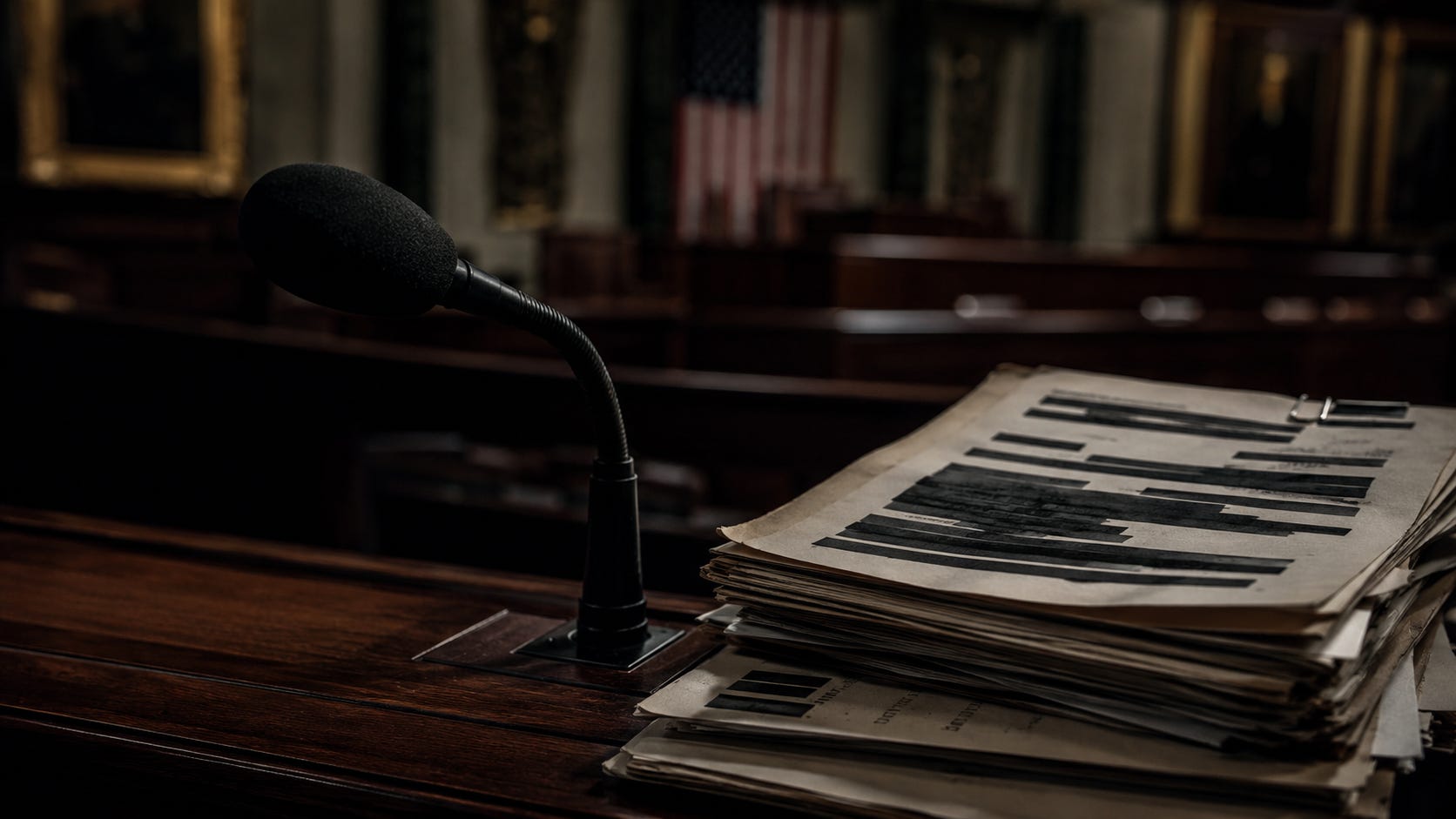
Massie says victims’ lawyers have confirmed that their own 302 forms, the FBI’s standardized interview records, have not been released. Millions of files remain sealed. The redactions, he says, are unlawful, not protective.
He went further. He accused Blanche and Patel of perjuring themselves when they said the network ended with Epstein. He invoked the First Lady, of all people, as someone who “knows Jeffrey Epstein didn’t act alone.”
If the official story is that there is nothing left to find, why is there a seven-month-long campaign already being announced by an outgoing congressman with legal immunity? Institutions with nothing to hide do not produce defectors who promise to read documents aloud from the well of the House.
The Power Map
The actors stack quickly.
Massie. No future political career to protect. Already absorbed the worst the party could deliver. Has constitutional immunity, House floor access, and an existing partnership with Rep. Ro Khanna (D-CA), who has been pushing on the same lever from the Democratic side.
Acting AG Todd Blanche. Trump’s former personal defense attorney. Now running the institution that controls the redaction machine.
FBI Director Kash Patel. Public face of the “nothing more to see” position. Per Massie, both men have perjured themselves on the public record.
The unnamed. The people in the redactions. The names protected by black ink. They are the entire reason the institution is holding the line.
The victims. Plaintiffs whose own statements, per their attorneys, remain unreleased.
The First Lady. Massie named her specifically as someone who privately rejects the official line. That is not an accident. It is a wedge.
The hidden network is the entire game. Everyone else is either guarding it or trying to expose it.
The CRIX22 Read: Chaos Negotiation
Chaos Negotiation activates when a player’s Credible Loss Acceptance breaks the opponent’s leverage model.
Institutional power runs on a simple assumption. The target still wants something the institution can take away. A seat. A committee assignment. A future. A reputation. A donor base.
Massie just had the most important one of those forcibly removed. The institution itself disciplined him out of office. Whatever leverage the DOJ, the party leadership, or the network’s protectors had over him in 2024 evaporated the night he lost.
What the institution has now is seven months of a congressman it cannot threaten, cannot bribe, cannot promote, cannot demote, and cannot prosecute for floor speech. That is not a manageable problem. That is a hole in the leverage model.
The cover-up architecture was built for actors who care about consequences. It was not built for a defeated incumbent with a microphone and a calendar.
Who Gets Protected
Whoever is in the redactions. Whoever shows up in the unreleased 302s. Whoever benefited when Blanche and Patel said the investigation was effectively closed. Whoever wrote the cooperation arrangements around Epstein and Ghislaine Maxwell that never expanded into a co-conspirator prosecution.
The institutional officials are protected only as long as the narrative holds. Once names start being read into the Congressional Record, the protection loses oxygen fast. You can suppress files. You cannot suppress a transcript.
Who Gets Used
The victims, first. Massie’s most damaging line was not about Trump or Melania. It was about convictions. He said convictions are not possible “with Todd Blanche at the top and Kash Patel at the top.” Translation: the people legally responsible for prosecution are the people the victims’ lawyers say are blocking it.
The public, second. Years of officials saying the investigation is closed have produced a population that is now expected to believe a man who trafficked minors for two decades had no operational network. The 22% Constant exists precisely for that gap between what is being said and what is structurally possible.
Public trust in the DOJ pays the bill either way. If Massie reads names and the DOJ confirms nothing, the institution loses interpretive authority. If the DOJ confirms even one name, the entire official line collapses retroactively.
The Next Pressure Point
Two specific calendar events to watch.
First: the next floor speech where Massie or Khanna invokes the Speech or Debate Clause to read material from the files. The DOJ has no legal counter. Its only response is media management.
Second: any document release timed to land between now and Massie’s exit. The institution will try to control which names break first, by releasing partially redacted material on its own schedule, to neutralize anything Massie says afterward.
If the institution gets ahead of him, it survives. If Massie gets ahead of the institution, the narrative inverts.
Signals Before The Break
Sudden DOJ “transparency” releases timed to weekends or major news cycles
New House rules, real or proposed, restricting what members can read into the record
Quiet reassignments inside DOJ Office of Information Policy or FBI Records Management
A coordinated media wave reframing Massie as unstable, irresponsible, or compromised
New civil filings by victim attorneys naming specific redacted figures
Republican leadership publicly distancing itself from Massie’s seven-month plan
Ro Khanna echoing or amplifying Massie from the Democratic side
Final Read
The institution disciplined the wrong man at the wrong time. It removed his future and forgot he still owns his present. Seven months is a long calendar for a man with no career left to lose and a microphone the law cannot turn off.
The redactions were the wall. Massie just got handed the hammer the system itself sharpened.