
Prophet Jiang Is Wrong About Iran
How “China’s Nostradamus” and his Predictive History YouTube prophecy misread Trump’s Iran war
This analysis is built on simulations we ran at Crix22, where we design crisis and strategy simulations for both geopolitics and business—so leaders can play out the decisions before they count.
I. How Jiang Got Famous (And Why He’s Only Half Right)
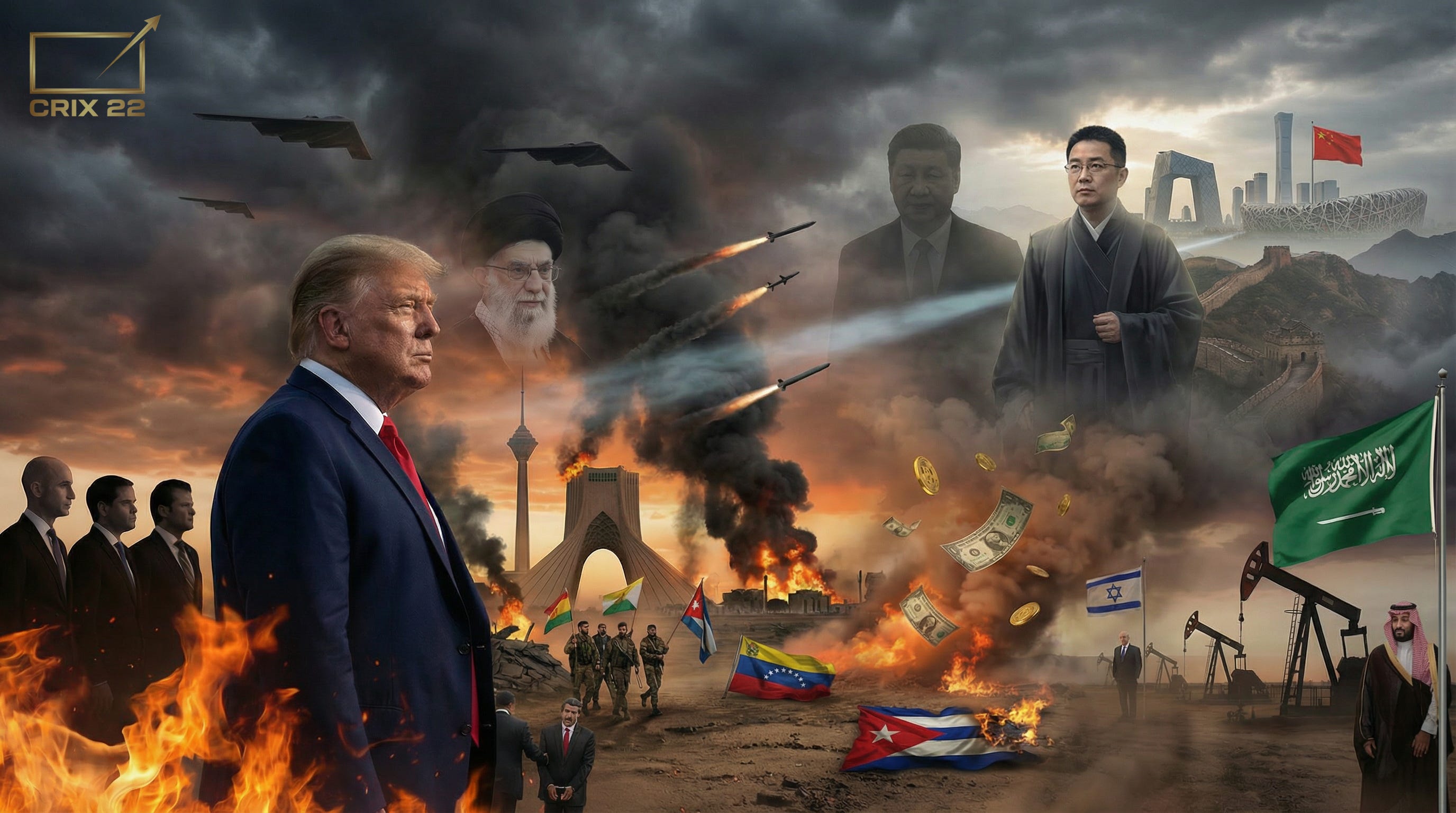
In May 2024, a Beijing educator named Jiang Xueqin sat in front of a camera and made three predictions: Trump wins the election. America goes to war with Iran. America loses.
By early 2026, two of those predictions had materialized. Jiang’s YouTube channel and Substack, both called Predictive History, exploded past 1.8 million subscribers after his Iran video. Newsweek covered him. Outlets across Asia and the Middle East ran his face. The internet gave him a name: China’s Nostradamus.
Jiang earned the attention. His methodology—pattern-matching historical cycles using game theory and structural analysis—is genuinely interesting. His Sicilian Expedition analogy, comparing a potential U.S. invasion of Iran to Athens’ catastrophic overreach into Sicily in 415 BCE, is the kind of framework that makes people see geopolitics differently. He called the Trump win. He called the Iran escalation. That’s not luck.
But prediction two out of three is not prophecy. It’s a batting average. And the third prediction—the one that made Predictive History famous, the one his audience is waiting on—is dead wrong.
II. The Part Jiang Totally Missed
Jiang predicted America would lose in Iran the way Athens lost in Sicily. He’s wrong—not directionally, not partially—but structurally. Predictive History is predicting a war that isn’t being fought.
There is no ground invasion. There are no mass casualties. There is no Next Iraq. The war was won at the Treasury long before the first missile left its rail. Trump isn’t posing on a carrier deck—he’s already in the next room, moving pieces toward Cuba.
Jiang’s model assumes America is charging blindly into Iran: overconfident, overextended, no exit strategy. What Predictive History cannot see is an America that already discounted Iran as a permanent problem and priced it as a door—a necessary opening in a corridor that leads somewhere else entirely.
It’s also worth noting what Predictive History can’t see about its own creator. A Free Press investigation published this month revealed that Jiang also promotes conspiracy theories involving Freemasons, Jesuits, and a defunct Jewish cult allegedly conspiring to rule the world from Jerusalem. The telescope sees far. The astronomer has blind spots of his own.
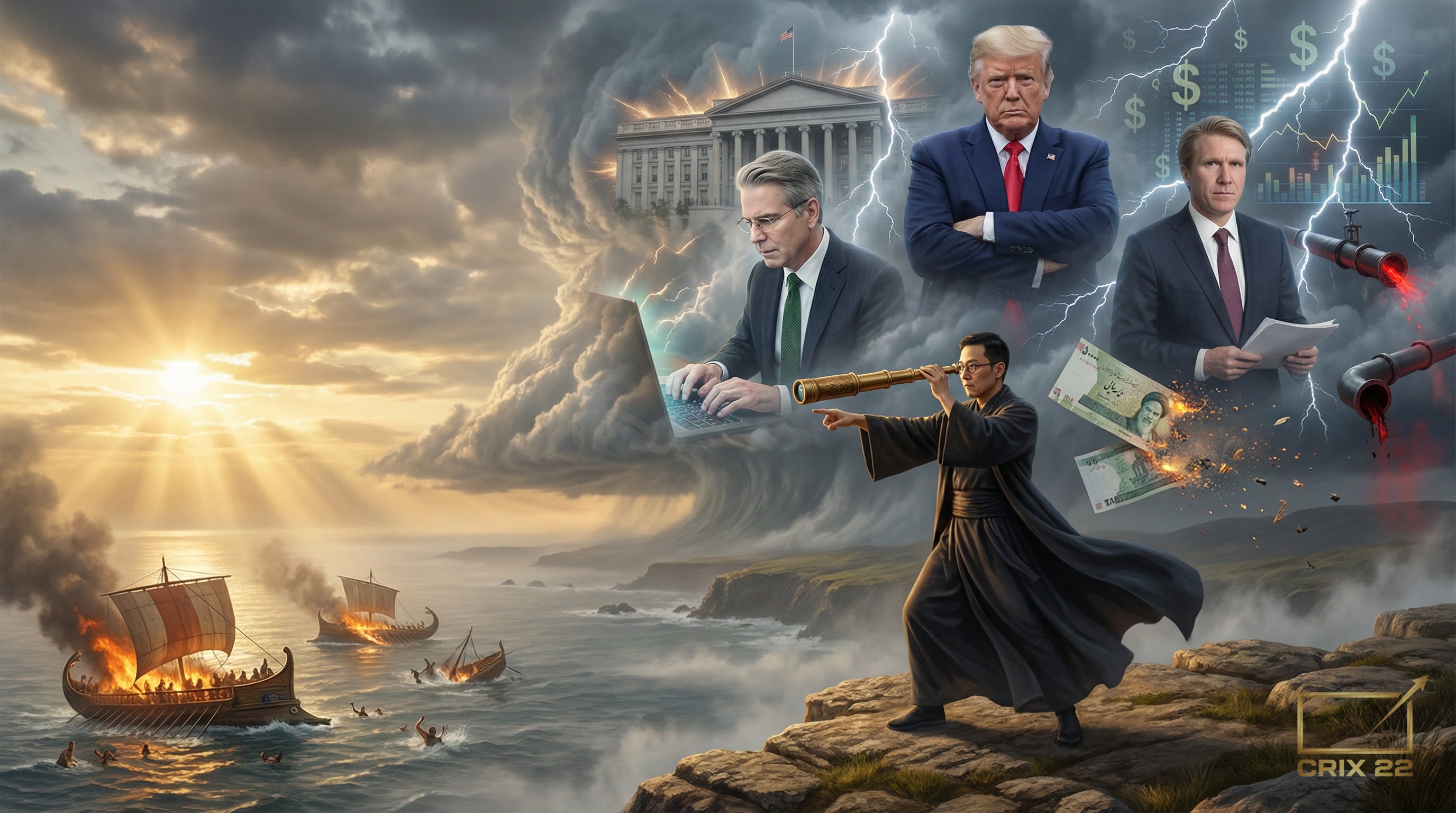
But Jiang’s popularity proves something important: there is massive demand for the kind of analysis Predictive History promises—connecting historical patterns to real-time geopolitical events and showing people what’s coming before it arrives. The problem isn’t the premise. It’s the instrument. What you’re reading right now is the first case study in a different approach—one that keeps the pattern recognition but adds the doctrine-level specificity that Jiang’s framework misses. The patterns matter. But so do the people running the plays.
At Crix22, we build the same kind of simulations for companies and institutions that need to war-game product launches, crises, and high-stakes negotiations before they step into them.
So what did Jiang miss? Start with the doctrine.
III. The Playbook Jiang Never Modeled
Predictive History sees empires. It doesn’t see playbooks. That’s the gap that breaks Jiang’s prediction.
The National Security Strategy of 2017 named China as the primary threat to American global dominance. Not Iran. Not Russia. China. Everything since has been sequencing toward that confrontation. Iran was in the way—not because Iran is powerful, but because Iran is useful to Beijing:
— Iranian oil keeps Chinese industry running at below-market prices.
— Iranian proxies keep American attention pinned in the Middle East.
— Iranian nuclear ambition forces permanent American crisis management.
— Iran carries China’s water in the region much as Israel carries America’s.
Remove Iran. Free the bandwidth. Move the fight to where it was always going.
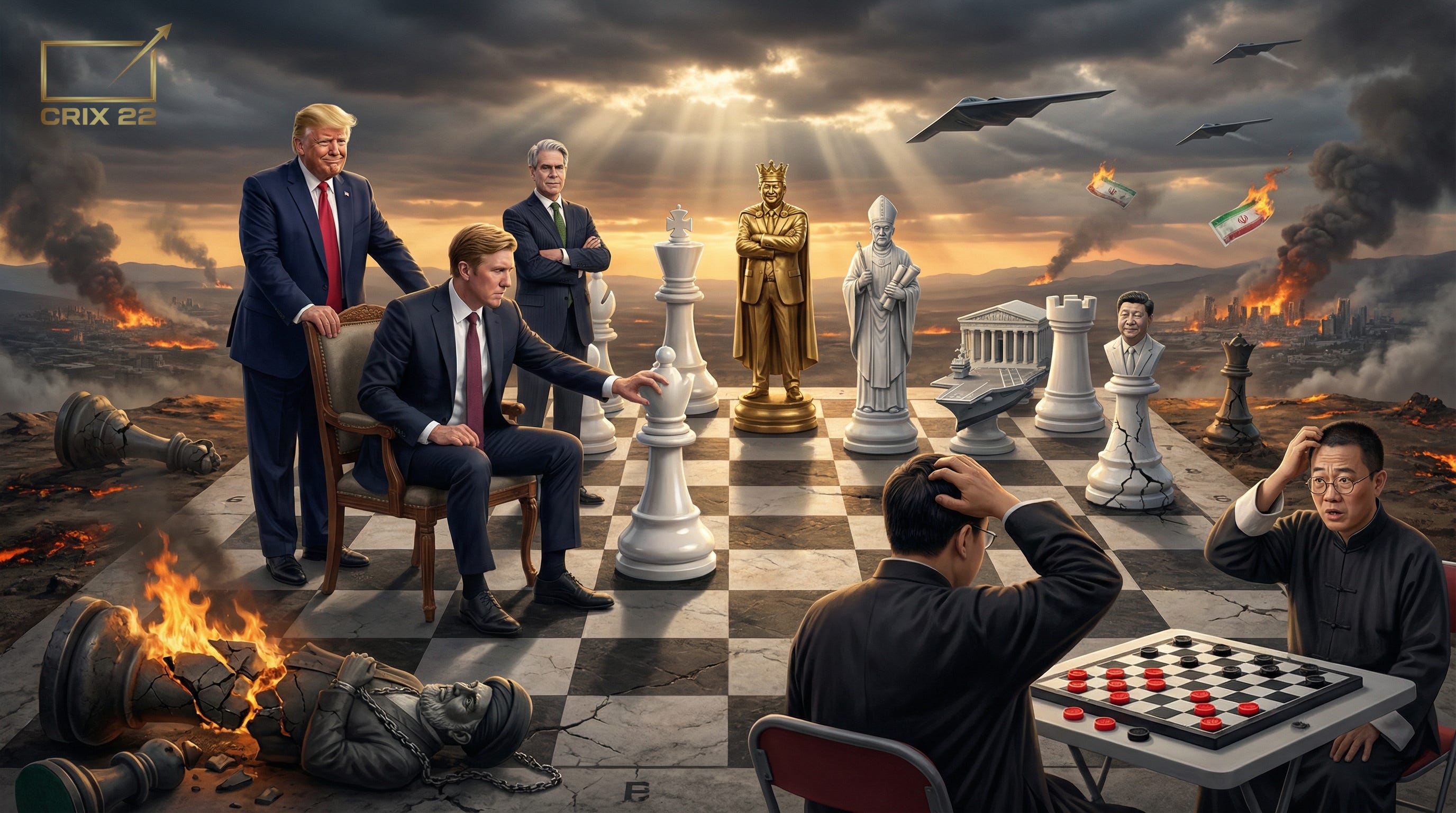
At the center of this logic sits Elbridge Colby—lead architect of the 2018 National Defense Strategy, now Under Secretary of Defense for Policy. Colby turned America First into a sequencing algorithm: China is the only peer rival. Europe handles Russia. The Middle East gets contained cheaply. The Western Hemisphere gets locked down under a revived Monroe Doctrine. American hard power concentrates in the Indo-Pacific.
From the outside, this looks like chaos: Trump buying Greenland, berating Europeans, threatening NATO. Inside the playbook, it’s the most coherent foreign-policy apparatus in decades—running opposite to the neocon crusades that Jiang’s model assumes are still in effect.
Jiang is using a map of American foreign policy circa 2003. The terrain changed. That’s what Predictive History missed about Iran—now watch what happens when you follow the money.
IV. The War Jiang Can’t See: China, Not Iran
Here’s what Predictive History never modeled: Iran isn’t the target. It’s the supply line.
Combined, Iranian and Venezuelan crude account for nearly 18 percent of China’s seaborne oil imports—purchased at $8–10 below market per barrel, because U.S. sanctions killed every other major buyer. China absorbs roughly 80 percent of all Iranian oil exports. Remove Iran and Venezuela and you’ve quietly dismantled a fifth of China’s seaborne energy supply without firing a shot at a Chinese asset or giving Beijing a casus belli for anything.
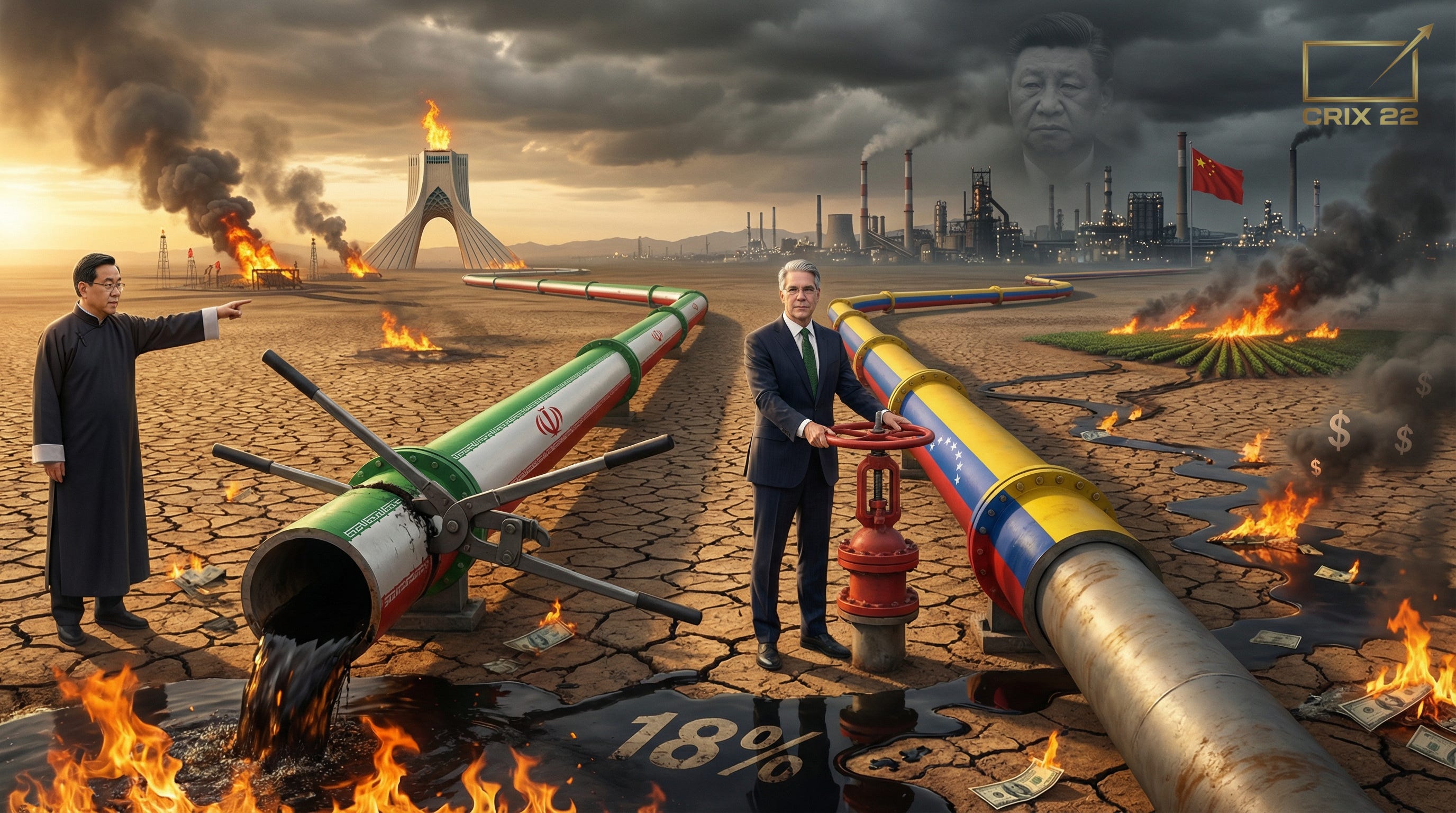
That is not a Middle East policy. That is an economic siege on China conducted through the Middle East and South America. The geography is the misdirection. Jiang sees an Iran war. The playbook sees an energy war—and Iran is just the weakest node.
There’s a complication the playbook may underestimate: if Iranian and Venezuelan crude both exit China’s discount pipeline, Beijing’s fallback is Russian oil—a single supplier with his own leverage and his own evolving relationship with Washington. That could create useful friction between Moscow and Beijing, or it could forge a tighter energy bloc operating outside the dollar. It’s the one variable in the sequencing doctrine that hasn’t been stress-tested, and it deserves more attention than it’s getting.
Meanwhile, the petrodollar constrains both sides. Saudi Arabia prices oil in dollars—that’s what makes the dollar the reserve currency, which is what lets the U.S. run massive deficits. If the Strait of Hormuz closes, the petrodollar cracks. Trump’s real constraint isn’t military. It’s financial. He cannot let this spiral into Gulf disruption.
Jiang’s Sicilian Expedition analogy fails for a reason Predictive History never identifies: Athens didn’t have a financial system that would collapse if the war went too long. Trump does. That’s not a weakness—it’s a leash. And it’s the leash that prevents the catastrophe Jiang predicts.
So if Iran isn’t the real war, how do you fight the real war without creating Iraq 2.0?
V. The Treasury War: How Bessent Beat Iran Before the Bombs Dropped
This is where Jiang’s prediction collapses completely. Predictive History assumes a ground invasion because that’s what the historical pattern demands. What actually happened is that Treasury Secretary Scott Bessent ran the war from a keyboard—financial strangulation first, limited strikes second, no boots on the ground ever.
Bessent announced it at the Economic Club of New York in March 2025: “Making Iran Broke Again.” Cut oil exports. Sever dollar access. Target banking infrastructure.

In December 2025, Ayandeh Bank, one of Iran’s largest banks collapsed. The currency cratered. Imports froze. The security apparatus couldn’t make payroll. Protests erupted. In January 2026, Bessent went on Fox News and took explicit credit—citing the bank failure, the currency crisis, and the protests as proof the campaign had delivered.
The economic conditions were engineered. The protests were their inevitable product. By the time the first strike hit Iranian nuclear infrastructure, the economy had been on life support for months. The military option wasn’t the opening move. It was the closing argument.
Jiang modeled a war of attrition. What happened was a leveraged buyout. Iran was the proof of concept—but the concept was never about Iran. It was about proving you can collapse a node in China’s support system without creating the quagmire Predictive History is waiting for.
But if the method works, why can’t Jiang’s framework see it?
VI. Why “Predictive History” Breaks Here
Jiang’s methodology is a telescope. It sees far. It cannot see what’s directly in front of it—and that’s why Predictive History breaks on this specific conflict.
Pattern-matching works when empires repeat themselves. Feed the model enough cycles of overreach and it produces recognizable shapes. The pattern Jiang identified—hubris leading to quagmire—is real. It has happened. It will happen again. It’s just not happening here.
The methodology reads systems. It can’t read rooms. It identifies what empires have done in aggregate and projects forward. What it can’t account for is a specific doctrine, written by specific people, handed to an executor with no institutional resistance. History doesn’t give you Elbridge Colby. It gives you the category “defense strategist.” History doesn’t give you Scott Bessent at the Economic Club. It gives you the category “economic pressure.” The specific is where the prediction lives. The aggregate is where Jiang lives.
The Sicilian Expedition failed because Athens had no doctrine, no sequencing, no defined objective. If Colby’s published framework is taken at face value, the men running this operation know what winning looks like—and it has nothing to do with governing Iran.
But here’s where we should be honest about what Jiang gets right in spirit, even if his mechanism is wrong.
Even if Iran fractures on schedule, you’ve created a power vacuum with nuclear material potentially unsecured, no successor state, and every regional actor from Turkey to Saudi Arabia to Israel with incompatible plans for what fills the space. The Trump team has outsourced this—Gulf monarchies absorb chaos, Israel secures nuclear sites. That’s the plan. Plans have a way of meeting reality. The gap between winning a war and owning its consequences is where empires actually break. Jiang won’t be right about the Sicilian Expedition. But he may be right about something deeper—and dismissing that concern entirely would be our own version of the blind spot we’re diagnosing in him.
With that on the table—what does the evidence actually point toward? And what can’t Jiang’s model see about the man executing the playbook?
VII. The Trump Variable Jiang Can’t Graph
Jiang’s model has a doctrine problem. It also has a man problem. And the man is the reason the Sicilian Expedition—the scenario Predictive History is built on—never starts.
Trump is not a vessel for structural forces. He’s the variable that breaks structural models entirely. Jiang’s methodology assumes rational agents responding to incentives. Trump responds to one incentive: what this looks like on television in six months.
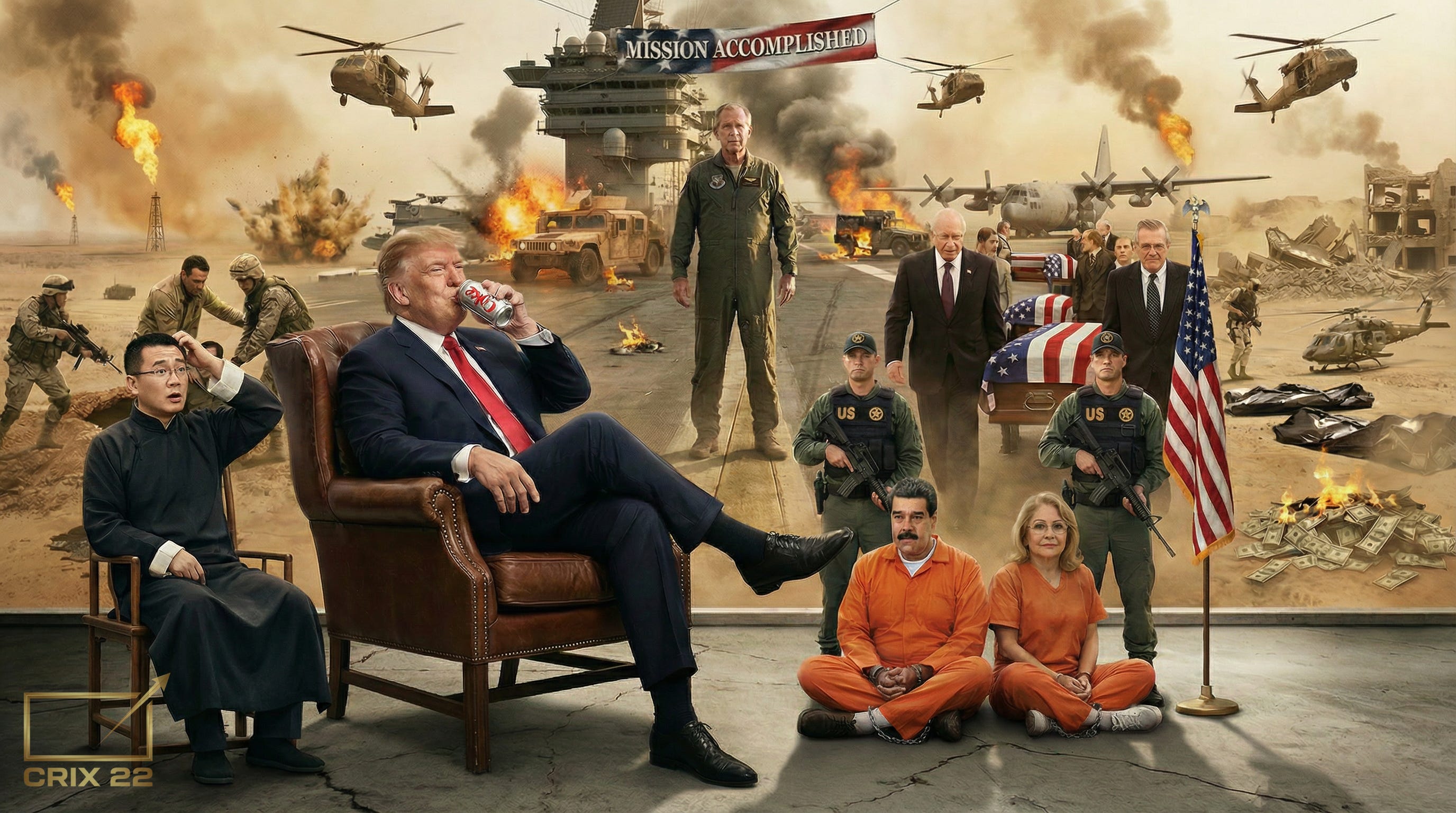
His entire political identity is built on not being George W. Bush. No Iraq’s. No nation-building. No coffins. His base elected the man who called neoconservatism a catastrophe. The tools he reaches for are the ones where other people carry the physical risk: proxies, airpower, sanctions, financial strangulation. Short bursts of force plus economic pressure to force a deal.
Venezuela proved the pattern. On January 3, 2026, Delta Force breached Maduro’s compound, captured him and his wife, and flew them to New York on narco-terrorism charges. The political aftermath is messy—a Maduro ally became acting president, the opposition leader is sidelined—but the operational objective was achieved: regime decapitated, minimal American casualties, spectacle dominated the news cycle.
Predictive History can’t model this because the pattern it’s matching—long occupation, quagmire, imperial exhaustion—requires a president willing to occupy. Trump’s psychology makes that impossible. The variable breaks the pattern.
So if the playbook works and the man won’t let it become Iraq—what’s already happening on the ground?
VIII. What’s Already Happening (That Jiang Can’t See)
While Predictive History waits for the ground invasion that proves Jiang right, the actual operation is already running—and it looks nothing like the Sicilian Expedition.
Iran doesn’t fall like a conventional defeat. It fractures. The Coalition of Political Forces of Iranian Kurdistan formed on February 22, 2026—one week before the bombing campaign. The founding members represent an estimated 8,000–10,000 fighters with territorial presence in Iraqi Kurdistan, supply lines, and grievances that need no American narrative to sustain. The role isn’t conquest. It’s fragmentation.
Economic collapse at the center. Ethnic pressure from the west. Airstrikes degrading infrastructure. A security apparatus that can’t hold the periphery when it can’t make payroll.
Trump doesn’t need to install a government. He needs a phone number—someone who controls enough territory to take his call and guarantee Iranian oil flows again in dollars through channels Riyadh can live with. The negotiation will be called a peace deal. It will look like a Trump win. It will be a Trump win.
The Sicilian Expedition required Athens to govern what it conquered. This requires nothing of the kind. Break it enough that the right person calls. Then take the call.
The call hasn’t come yet. But the sequencing didn’t wait for it.
IX. The Twist Ending: Cuba, Panama, Then Beijing
While Jiang’s audience watches Iran waiting for the quagmire Predictive History promised, the playbook has already moved to its next node.
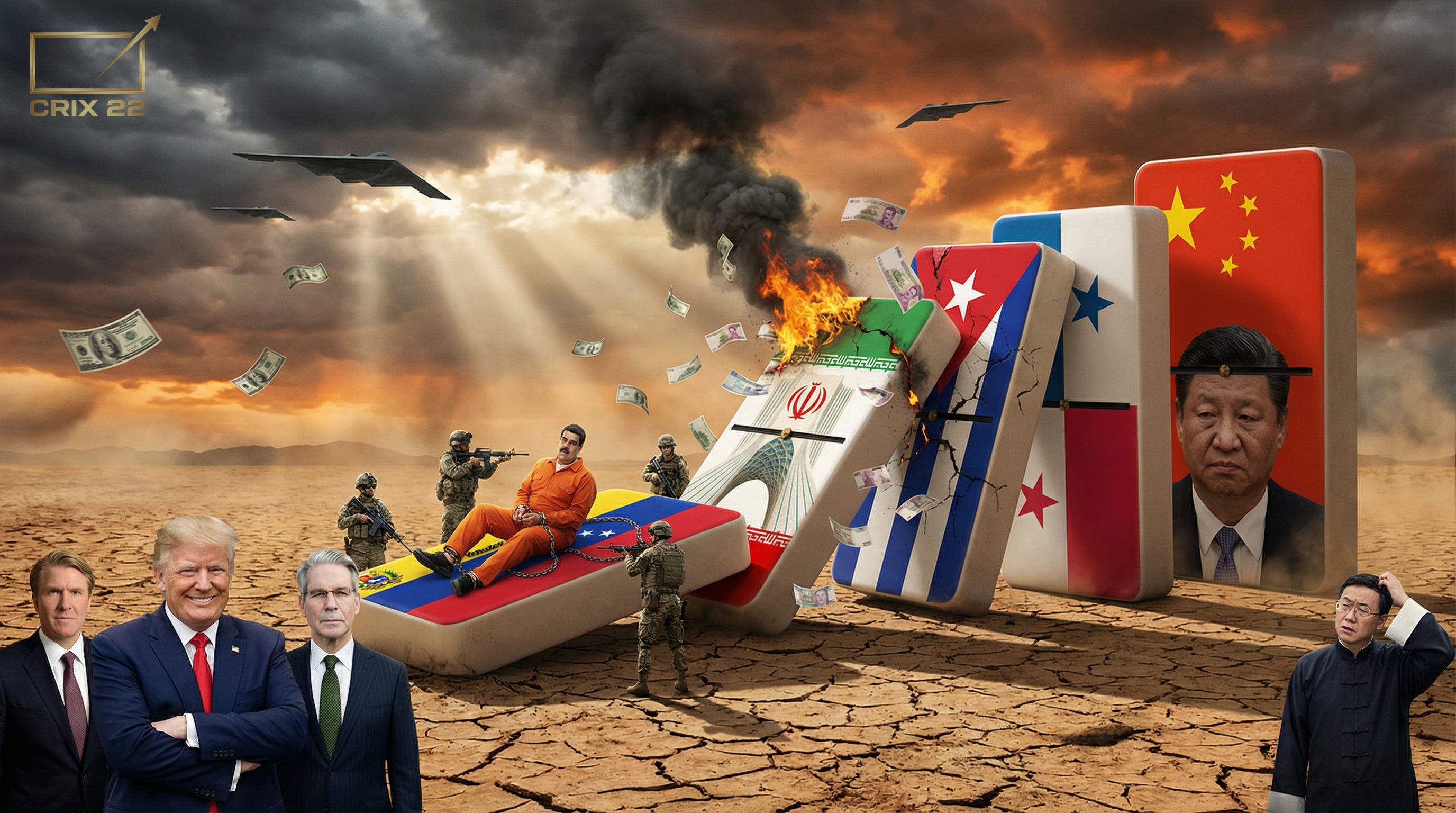
Venezuela removed China’s primary energy proxy in South America and opened 303 billion barrels of reserves to American companies. Panama’s Supreme Court overturned CK Hutchison’s port concession; a BlackRock-led consortium is positioned to take both ends of the Canal. Republican lawmakers said openly, the day Maduro was captured, that Cuba and Nicaragua would not survive this administration.
Cuba sits ninety miles off Florida: economically terminal, dependent on Venezuelan oil that no longer flows, with Chinese surveillance infrastructure on the island. The 2025 NSS’s “Trump Corollary to the Monroe Doctrine” commits the U.S. to targeting “strategically important locations” where non-Hemispheric competitors have footholds. Reports in late 2025 indicated the PLA was war-gaming Western Hemisphere combat scenarios.
Colby’s framework moves from the Middle East to the Western Hemisphere to the Indo-Pacific. Each node removed is a Chinese dependency eliminated, a chokepoint secured, a distraction cleared before the main event.
Jiang saw a war. It was never a war. It was a sequence—and the sequence doesn’t end until it reaches Beijing.
Predictive History taught millions of people to look for patterns. That’s valuable. But patterns without doctrine are just shapes in the fog. We’re building the instrument that clears it—and this is the first thing it sees.
About Crix22
Crix22 builds crisis and strategy simulations for both geopolitics and business. We put leaders and teams inside unfolding scenarios—wars, market shocks, PR fires, product launches—and let them play the decisions before they count. If you want to see how this works for your team, visit crix22.com.
Predictive History | Respect…