
The Vatican Is 1,800 Years Late On Slavery. It Is Trying Not To Be Late On AI.
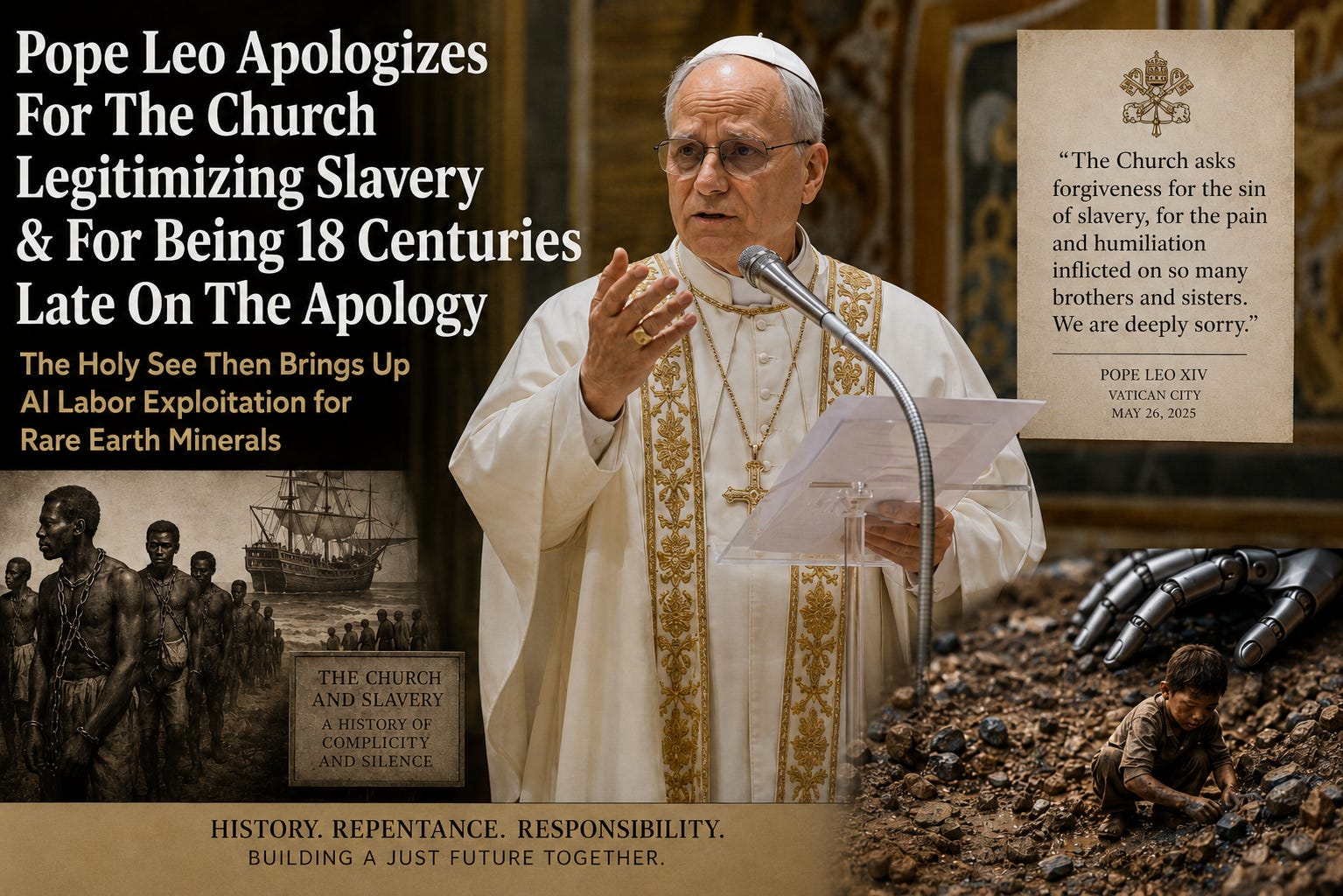
Pope Leo XIV’s first encyclical pairs a historic slavery apology with a warning about child miners crushing rare earth for AI chips. What's the connection? It's preparation for the next 10 years.
The Door They Left Open
Most coverage of Pope Leo XIV’s first encyclical, Magnifica Humanitas, stops at the slavery apology. That is the half people were expecting. That is the half that travels.
But the encyclical is 43,000 words. The slavery confession is the opening. The closing is about artificial intelligence.
In the same document, Pope Leo writes:
“In some regions of the world, children and adolescents work in dangerous conditions, crushing the materials from which rare earth elements are extracted. The bodies of these people are scarred, injured, and worn down so that computational flow may continue uninterruptedly.”
And then the operative line, the one that turns the whole encyclical into something other than a confession:
“...if we want to avoid the need to ask for pardon again in the future for having failed to respect the treasure of human dignity that is required by our faith.”
That is not a sentence about the past. That is a sentence about positioning for the next 10 years.
The Official Story
The public version is moral progress. The first American pope publicly admits the Vatican’s role in the transatlantic slave trade. He calls it a “wound in Christian memory.” He acknowledges 15th-century papal bulls that authorized European monarchies to conquer and enslave “infidels.” He apologizes on behalf of an institution claiming 1.4 billion members.
This is historic. It is also true. Black Catholics, activists, and historians have demanded exactly this acknowledgment for decades.
But the encyclical did not stop there. And the part it did not stop at is where the strategy lives.
The Part That Does Not Fit
If the encyclical were only about slavery, it would close after the apology. It does not.
Pope Leo names cobalt and rare earth mining. He names children. He names “computational flow.” He links the 15th-century papal authorization of subjugation to 21st-century supply chains feeding the AI economy. He explicitly says the modern Church must condemn all forms of trafficking driven by the digital revolution.
Why would a slavery apology contain a chapter on tech labor?
Because the slavery apology is the down payment.
The Power Map
The 15th-century papal bulls — Dum Diversas (1452) and Romanus Pontifex (1455) — were diplomatic licenses. They underwrote the Doctrine of Discovery, the legal scaffold European empires used for four centuries of colonial conquest. The Catholic Church did not condemn slavery until 1888, under Pope Leo XIII. By then the United States had been free of slavery for 23 years, the British Empire for 55, and Brazil — the last Western country to abolish — did so the same year.
The Church did not lead abolition. It caught up to it.
Pope Leo XIV is now positioning the Church to do the opposite on AI:
The Vatican itself, a sovereign-state-level institution with 1.4 billion members and a media reach no tech company can match.
Pope Leo XIV, the first American pope, with ancestry that includes both enslaved people and slave owners (per genealogical research by Henry Louis Gates Jr.), whose personal biography gives the apology unique moral force.
The AI industry, building its entire infrastructure on rare earth supply chains in the Democratic Republic of Congo, Indonesia, Bolivia, and elsewhere — supply chains the encyclical just named.
Tech labor and child miners, named in the document but with no enforcement mechanism following.
The encyclical does not regulate anything. It claims jurisdiction. That is the move.
The CRIX22 Read: Anticipatory Intelligence & Temporal Pressure
Every institution has a decision-making speed. Every public crisis has a velocity. When the crisis moves faster than the institution, the institution loses tempo control. It can still hold formal authority, but it stops shaping events and starts apologizing for them.
The Catholic Church lost tempo on slavery by 18 centuries. The encyclical admits it directly.
AI labor exploitation is moving faster than the transatlantic slave trade ever did. The supply chains exist now. The harm is documented now. The scale is mounting now. A Church that took 1,800 years to catch up the last time cannot afford the same delay this time. Pope Leo is using the apology as evidence of awareness: we know what late looks like, and we will not be late again.
The confession buys the airtime. The pivot is the actual play.
Who Gets Protected
The Vatican’s forward authority. A confessed institution has more credibility to weigh in on future fights than an unconfessed one. The slavery apology cleans the ledger.
Pope Leo XIV’s legacy. First American pope. First encyclical. Two civilizational fronts addressed in 43,000 words. Legacy locked in.
The Church’s relevance in the next 10 years. By naming AI labor explicitly, the Vatican stakes out moral territory before secular institutions, governments, or activist coalitions can fully claim it.
Vatican assets. There is no reparations framework attached to the slavery apology. The confession is moral, not material.
Who Gets Used
The descendants of the enslaved, offered “deep sorrow” without a settlement attached, and now reduced to historical context for a forward-looking AI argument.
Current rare earth miners, named in the encyclical as bodies “scarred, injured, and worn down,” with no enforcement mechanism behind the naming.
AI ethics organizations that have done years of work in this space, now orbiting around a Vatican framing they did not write.
AI companies and tech investors, who now have a 1.4 billion-member institution forming on their moral flank, citing 15th-century papal authority over questions of human dignity in supply chains.
Public memory of slavery, smoothed over by Leo’s line that “judging the morality of decisions by today’s standards is not possible” — a phrase that softens accountability for the past while leveraging it for the future.
The Next Pressure Point
Whether the Vatican names a specific company, country, or supply chain in a follow-up document. The encyclical is general. The next statement will not be.
Watch for Holy See positions at the UN, G20, and World Economic Forum on AI labor. Watch for Catholic universities and pension funds reviewing AI exposure in their portfolios. Watch for the first diocese to divest from a named tech holding citing Magnifica Humanitas as moral precedent.
Signals Before The Break
Vatican AI ethics statements citing Magnifica Humanitas as binding moral framework.
Catholic university divestments from tech firms with documented supply-chain labor issues.
Black Catholic organizations questioning whether the slavery apology is being spent on the AI pivot rather than on reparations.
Holy See speeches at major economic forums naming specific industries.
Vatican Bank disclosures on tech-sector holdings.
The first time a Catholic bishop publicly opposes a specific data-center build, mine permit, or AI partnership.
A papal audience that includes a tech CEO. Watch what gets said. Watch what does not.
Final Read
The slavery apology is what you were supposed to look at.
The AI chapter is what you weren’t.
The Vatican confessed to one war that was already over so it could enlist in the next one. The Church was 1,800 years late on the first. It has maybe 10 years on the second.
Either the institution finally got faster, or the next encyclical comes with the same apology, written in a different language, about a different commodity, signed by a different pope.